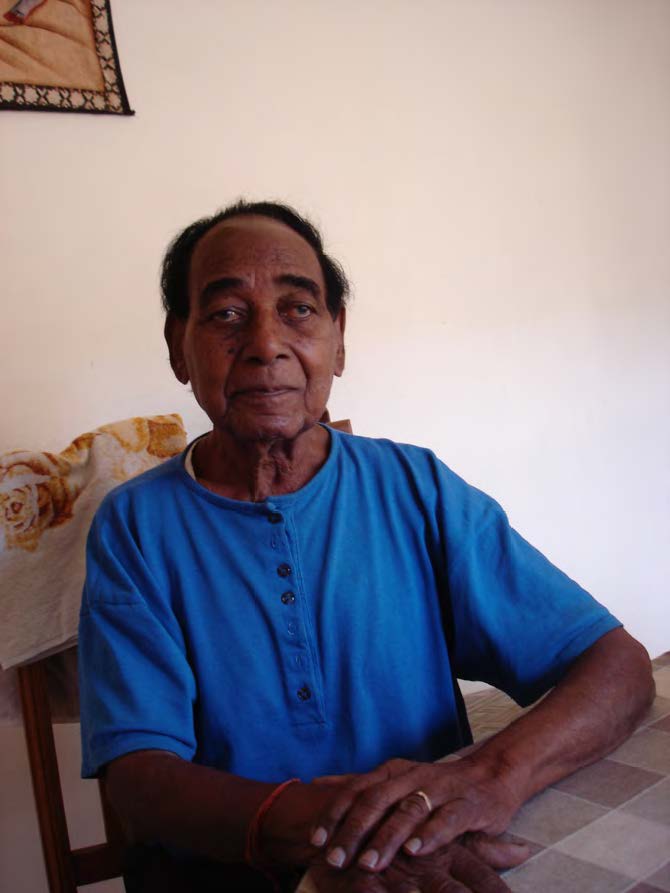
The Ramesar brothers may not have been well known to the vast majority of South Africans. In fact, most people would maybe not even recognize the surname. However, if you had a professional tattoo or knew someone who did it throughout most of the twentieth century, there was a one out of two chance that it was done by one of the Ramesar brothers (Hennig 1981). The only other competition was a tattoo artist in Cape Town (Magic Needle Caters For All Tastes 1956).
The two brothers in particular with ties to the professional tattoo industry were Beharie and Harry Ramesar. Their father arrived on the shores of Durban in around 1895 from India and settled in Pietermaritzburg. The Ramesar brothers, who were nine, had four sisters (van As 2009).
Beharie, the oldest Ramesar brother, learnt the tattoo trade from a German travelling circus that performed in Pietermaritzburg. Harry remarks in a newspaper article, published in the Natal Mercury in 1956 that: ‘he learnt the work from his brother who in turn was taught by a German circus star’ (Magic Needle Caters For All Tastes 1956). A touring circus that toured Pietermaritzburg in the 1920s was Pagel’s Mammoth Circus, which camped on a vacant lot, directly opposite the Norfolk Hotel in Upper Street (Dixon-Smith 2005).
Dixon-Smith writes in detail below, that the circus comprised of:
All Star Performers from the Principal Circuses of Europe and America… and Natalian’s of every race, colour and creed flocked to pay their admittance of 2, 3 or 4 shillings (children to matinees at one and two pence). Herr William Pagel was one of the greatest showmen of his day, and knew what the public wanted. He was German by birth (born in 1878) and after an early career at sea settled in Australia where he worked in a restaurant as dishwasher and bouncer. Extremely well-built (about 6 foot tall and between 280-‐300 lbs, with enormous forearms), he soon joined a circus as a strongman and eventually made enough capital to buy his own tent, holding 200 people. In February 1905 he sailed for Natal, and began touring South African centres. He developed his own animal training capabilities, particularly with lions, and carried the scars to prove it. Pagel was also famous for his tug o' war acts with four horses or alternatively with two elephants. He was renowned for carrying no stick or whip when in the ring, relying, as he himself said, on 'no more formidable instruments than patience, kindness and love, to gain a high degree of ascendancy over the minds of the most savage of the beasts of prey. Many people imagine that when an animal is taught to perform a feat, it is coerced into doing something foreign to its instincts and nature. This is not so. Animals possess aptitudes just as human beings, and they vary almost as greatly. The trainer observes some peculiar aptitude in an animal and guides and develops it carefully, encouraging him by every imaginable means until he is able to perform what is for that species of animal an unusual feat
(Dixon-Smith 2005)
Beharie therefore passed the tattoo trade onto Harry, who was in standard one at school at the time. Harry explains that he: ‘helped my brother trace patterns of national flags, pretty women and strong men as customers requested. Most of them were soldiers from the Indian Malay camp that came to Pietermaritzburg during World War II’ (Pillay 2001). With the tattoo knowledge that he gained under the guidance of his brother, Harry relocated to Durban after marrying Soonphathre and opened a small tattoo shop.
Harry established his tattoo studio in 1930 and occupied the same premises throughout his career: 125 Lakhani Chambers, 2 Saville Street. This was a predominantly Indian and African area of Durban, comprising mainly tailors, businessmen, herbalists, and salons (Pillay 2001).
Naidoo (1983: 9) described the interior of Harry’s tattoo studio as follows:
The walls of his small room are crammed with charts showing hundreds ofpatterns from which his clients select the design they want transferred permanently onto their skins. One corner of the room has a few chairs and serves as a waiting room on busy days. The only other furniture is a table with four small bottles of ink, a few cloths and a small electrical tattooing machine
(Naidoo 1983: 9)
Harry traces the history of tattooing back to the days when it was customary for Hindustani women to tattoo their arms soon after marriage. ‘When raiders attacked villages in India they would take women away after killing the men. But they left the women who had tattoos because they knew they were married’ (Naidoo 1983: 9 ).
The above-mentioned explanation could only speculate that Harry was referring to the tattoo history of India and not to tattoo history in its entirety.
The procedure of getting a professional tattoo has not changed considerably throughout the years since the invention of the electric tattoo machine by Charlie Wagner in 1981 (Clerk 2008). In a newspaper article printed in the Natal Mercury in March 1956, Harry explains his tattoo process.
The procedure mentioned on the right was narrated by Harry in 1956 and it is presumed that Harry adopted revised procedures as the tattoo technology of the times improved.
First, I have to shave my client's arm, then trace on it with indelible pencil one of my designs. Next, the electric needle – moving 1,000 times a minute – traces over the design in ink. There is no longer danger of blood poisoning because an antiseptic is added to the ink. Next comes the colouring. Certain colours – yellow and purple – are not used because they fade; but red, blue, green, brownand black are permanent
(Magic Needle Caters For All Tastes 1956).
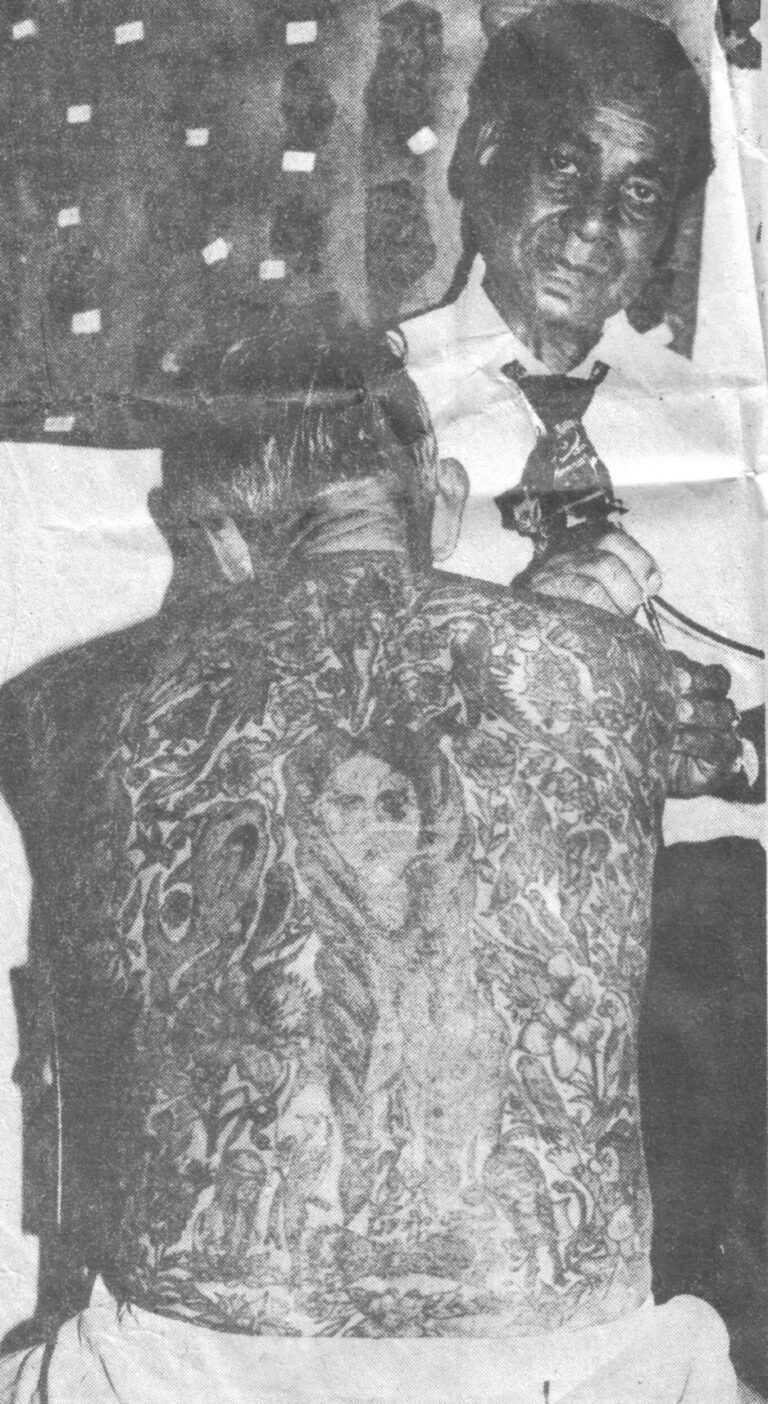
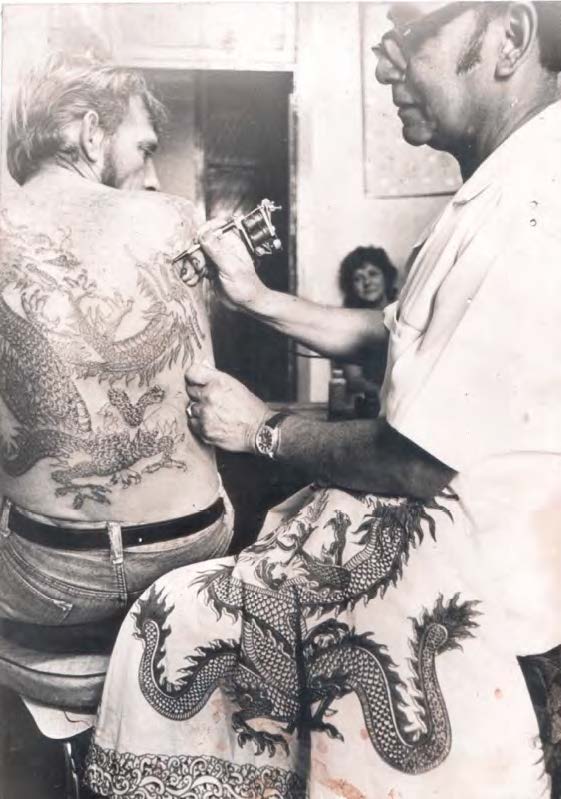
According to Naidoo, Harry states that ‘By far the most sought-after designs are eagles. Eagles make people feel bold and brave. It shows that they are one of the boys’ (Naidoo 1983). In an interview conducted by Doreen Premder in 1998, Harry remarked that: ‘men took a fancy to Eagles, Panthers, Dragons, and barbwire while women chose roses, butterflies and something more feminine – the simple ones’ (Premder 1998).
Cosmetic tattoos were also performed by Harry, where ‘most of my European women clients came for beauty spots… some women had black eyebrows tattooed and even red lips’ (Magic Needle Caters For All Tastes 1956).
It could be speculated that one of the most frequently asked questions that a tattoo artist receives is about the pain factor. Although pain thresholds vary from individual to individual, Harry remarked that: ‘It is completely painless, people have fallen asleep while I was tattooing them. They feel the pain only when I start, but the longer it takes the easier it becomes (Naidoo 1983).
One of his clients sat for two periods of ten hours each for an intricate design. Another has been returning regularly for the past twenty-five years – his body is now completely covered with ink-marks (Naidoo 1983).
South Africa was up until the dawn of democracy in 1994, a segregated population that lived under oppression from forces of colonialism and apartheid. Translated from the Afrikaans meaning ‘apartness’, apartheid was the ideology supported by the National Party (NP) government and was introduced in South Africa in 1948. Apartheid called for the separate development of the different racial groups in South Africa’ (South African History Online 2016).
In the midst of apartheid in 1956, Harry stated that two-thirds of his clientele were Europeans and on average he tattooed eight men a day and ten women a month and added that he also had non-European clients, with many Indian women going to him for religious marks. With regard to African clients, Harry referred to them as ‘natives’ in the article and notes the Paramount chief’s son as a prominent client (Magic Needle Caters For All Tastes 1956).
This cited newspaper article was written in 1956, therefore it is presumed that the term ‘natives’ was an accepted phrase utilised in society at the time.
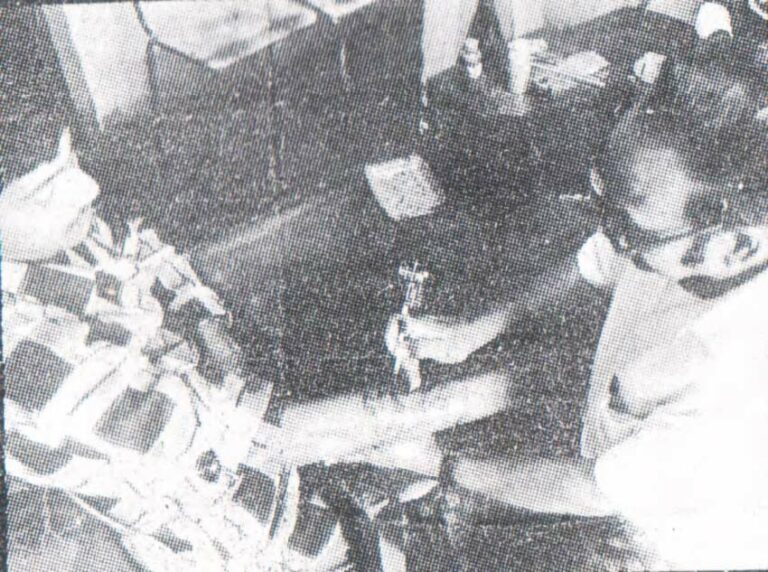
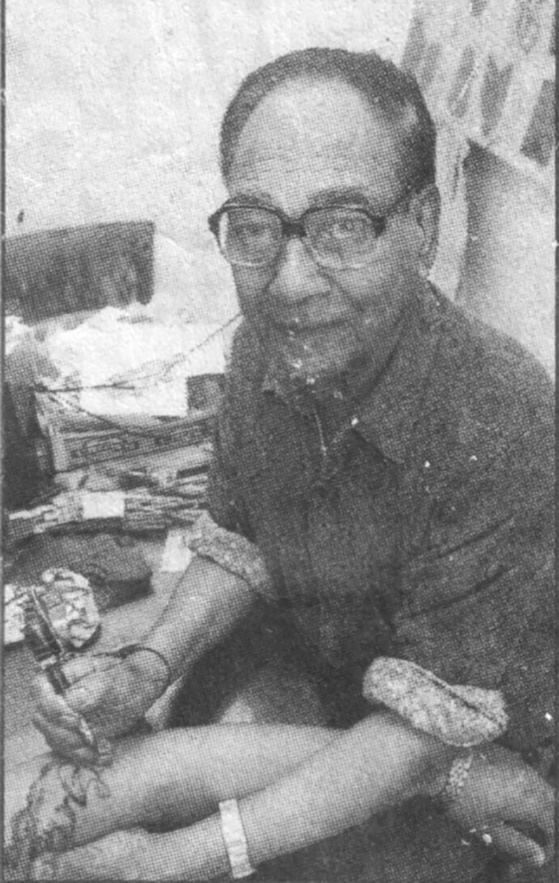
Some images of Harry working in his studio can be seen below. Harry remarks that in the early days most of his customers were sailors. A reason for this could be due to the fact that, a) South Africa was once part of the British empire and b) Durban was a very important strategic port for the allies during the world wars. According to Naidoo:
Time was the important thing in those days. The sailors were only allowed off the ship for a few hours, so we had to tattoo them in a very short time. Nowadays more and more ordinary people including many respected professional people are tattooing their bodies.
(Naidoo 1983)
Pillay refers to Harry building up a clientele that ranged from navy officers, soldiers, women interested in permanent lip colour and the notorious Hell’s Angels Bikers from the early 1960’s (Pillay 2001). Hennig remarks that Harry’s clientele included seamen, many of whom regarded the tattoo as a mark of their trade and ex-convicts, keen to change the shape of a tell-tale tattoo (Hennig 1981).
Then there are the women who change their tastes. Like the one who swopped ‘For Hells Angels Only’ imprinted around their midriff for a cover-up trellis of roses (Hennig 1981).
Research has revealled two individuals that fall into the category of royalty. The first was the then Prince of Wales whom Harry met in Beharie’s tattoo studio in Pietermaritzburg in 1925 (Pillay 2001).
The second and most esteemed customer as stated by Harry in 2001, a Newspaper article was King Cyprian BhekuZulu, the Zulu monarch. In the article, Pillay quotes Harry as saying:
He casually walked in but I knew he was somebody because of his three bodyguards. He asked me to do three heart tattoos on his arm – one with his father's name, the second with his name and the third he left vacant (Pillay 2001, para. 9).
(Pillay 2001, para. 9)
With regard to the age of tattoo clients, Harry remarked in a newspaper article published in 1956, that his:
…youngest client was a Rhodesian boy of seven, brought in by his mother to have a lion's head tattooed on his arm. This was his birthday present. His oldest client was a man of 84, who approached him for the third time to have this third wife's name tattooed over the names of his two deceased wives.
(Magic Needle Caters For All Tastes 1956).
Hennig documents the tattoo procedure in a newspaper article in June 1981, where she describes the tattoo experience of Pranesh Maharaj: Its Monday morning in Harry’s little workshop. A young man comes in. Pranesh Maharaj, 19, is an apprentice fitter and turner. All his friends have tattoos he says but his father made him wait until he finished school to have his done. Today’s the big day. He looks over the hundreds of transfers pasted on yellowed posters on the walls. From among the roses, swords, undressed ladies, cupids, sinking ships, hearts, birds, tigers, mermaids, he chooses an Atlas-‐type muscle man. Harry scrapes the hair from Pranesh’s right forearm with a razor blade. He wipes the skin with water then holds the indelible ink transfer in place for several minutes. His is the beginning of the sequence he has followed so often for so many years. Then he begins his human embroidery, tracing the outline with his spiked drill.
After a while Pranesh sinks slightly and asks for water. I can understand why. To get the feel. I asked Harry to write my name on my upper arm – without the ink. The pain was so intense, I stopped him after the ‘W’. no wonder some psychologists say tattoos can indicate a masochistic streak! ‘This only happens about once in 200 people. It’s nerves.’ says Harry as he waits for the recovery. ‘Usually after a couple of minutes, they don’t feel any more pain. ‘It’s a case of mind over matter. He’s thinking about it too much. ‘A half hour and a few more sips of water later, the picture is complete. ‘In about two hours’ time. Rub all the blood off with a wet rag,’ says Harry as he gives a final wipe to the rising red bubbles. ‘This time tomorrow spread on a thin layer of Vicks. Do that twice a day till the scabs fall off. ‘Don’t pick them or you’ll spoil it. Don’t rub it for two or three months and you’ll have nice thin lines. You can wash it whenever you like – water does not harm. Exit one satisfied customer. (Hennig 1981)
Due to the fact that tattoos are permanent, Harry remarked that because people selected their tattoos so carefully, it is possible to read a man’s character from his tattoos (Naidoo 1983). This could be due to the fact that people tattooed designs (a) on their bodies that they liked or (b) subject matter associated with groups they were affiliated too. Harry, therefore could pick up these character traits as a professional tattoo artist.
Throughout most of his career, Harry was not allowed to advertise his art, therefore he relied on word-of-mouth, and as a result, clients filtered in from all over the country (Hennig 1981). A large portion of Harry’s tattoo career took place during Apartheid and South African history online comments that newspapers catered mainly: ‘for white, upper-income city dwellers although most South Africans are neither white, well-paid; nor city dwellers (Online). In addition, the conversation regarding tattoos was not as mainstream and accepted as we observe today. Harry refused to tattoo people’s faces ‘on principle’ although he had been asked to do this many times. He also refused to tattoo young girls (Naidoo 1983).
Pillay asked Harry in a 2001 newspaper article when was he expected to retire. Harry, eighty-four years of age at the time replied:
It's going to be a while before I close up and retire. I love my job – meeting people and socialising with all sorts keeps me alive. 'The tattoo business is my life and until the day my legs give up I will continue coming to my shop and serving my customers'
(Pillay 2001)
Harry established his tattoo shop in 1930, in Durban and completed his last tattoo at the age of eighty-nine. When asked, what was the last tattoo that he ever did? Harry replied that it was flowers. With a smile on his face he said: ‘When you get old, you can’t be one hundred percent right. With flowers, you can go a bit crooked’ (van As 2009).
This works out to a professional tattoo artist career of an estimated seventy-four years. A truly remarkable achievement.
Clerk, C. 2008a. Vintage tattoos: A sourcebook for old-‐school designs and tattoo artists. London: Carlton Books Limited.
Dixon-Smith, R. 2005. A visit to the circus. Available: http://www.fad.co.za/Resources/contribs/rose/circus.php (Accessed 19 February 2018).
Hennig, W. 1981. EVERY MAN SHOULD HAVE A TATTOO. Sunday Tribune, 14 June 1981
Magic Needle Caters For All Tastes. 1956. The Natal Mercury, 15 March 1956
Naidoo, P. 1983. Living Art! Sunday Times
Pillay, P. 2001. An art etched in his heart. The Post, June 2001
Van As, R. 2009. Old School Uncovered-Western & European tattoo design & mythology.Durban University of Technology. Durban. November 2009.
van As, R. 2018. A Semiotic Investigation of the Graphic Imagery by Pioneer Tattoo Artists in KwaZulu-Natal with Special Reference to the Ramesar Brothers. Durban University of Technology